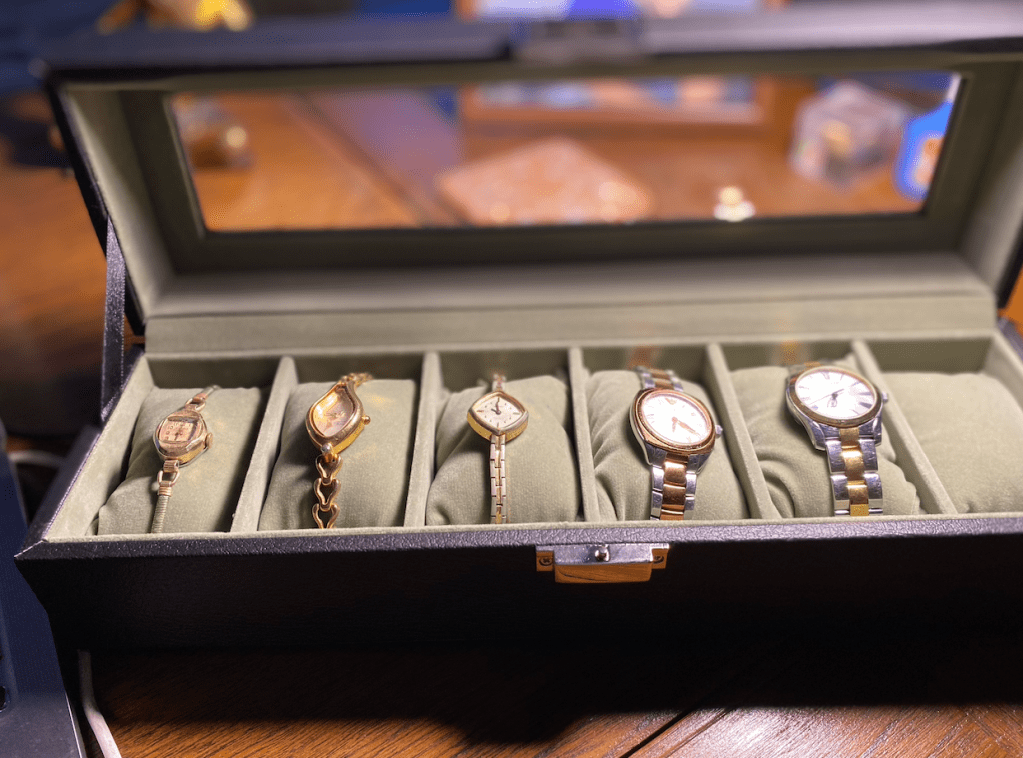
There is a small box sitting in my son’s room.
It is not an impressive box. Nothing about it would stop you in a shop. But what is inside it has stopped me more than once — not because of what it is worth, but because of what it means.
Inside are four watches. One belonged to his great-grandmother. One to his grandmother. One to his mother. And one — borrowed without negotiation, returned without incident — belongs to his sister Shaakya.
Four generations. Four women. Four lives lived, largely without fanfare, in the way most lives are lived. And my son Jaith, who has recently developed a quiet interest in watches, went looking for them. Not in shops. In family.
That, I think, is where this story really begins.
The Easy Path Was Not the One He Took
When Jaith’s interest in watches surfaced, the obvious move would have been to buy him one. Something new, something his, something that required no effort beyond a transaction.
But I asked him to look elsewhere first. I asked him to go to his grandparents. To dig around. To see what was sitting quietly in drawers and jewellery boxes, forgotten but not gone. To see if he could repair what he found, service it, restore it to something wearable.
He could have rolled his eyes. He didn’t.
He came back with a collection.
None of these watches are expensive. They would not impress a collector. They are simple, modest pieces — the kind worn by women who had other things to think about than what was on their wrist. But Jaith cleaned them up, got them ticking, and placed them carefully in that little box. And in doing so, he did something I did not expect: he gave those women back a small piece of presence in a house they no longer walk through.
We Have Confused Moving Forward With Leaving Behind
I am, by most accounts, a sucker for history. Those who know me know this. And I have noticed, over the years, that this tends to place you in one of two camps in people’s minds — the nostalgic, who are accused of living in the past, or the progressive, who are celebrated for leaving it behind.
I find both positions a little impoverished, honestly.
The nostalgic who refuses to learn from the past is merely sentimental. But the progressive who refuses to acknowledge it is building on ground they have not bothered to understand. You cannot know where you are going if you have no honest sense of where you came from — and more importantly, who carried you this far.
History is not a museum piece. It is not something you rope off and admire from a distance, or something you tear down because it makes you uncomfortable. It is the thing you are made of. The question is only whether you choose to know it.
Objects Carry What Words Often Cannot
There is something about a physical object — a watch, a ring, a worn-out book, a handwritten recipe on a scrap of paper — that does what stories alone sometimes cannot.
You can tell a child that their great-grandmother was a woman of discipline and quiet dignity. You can describe her. You can show photographs. But when that child holds something she held, winds something she wound, wears something that sat on her wrist through ordinary Tuesdays and significant Sundays — something shifts. The past stops being information and becomes, briefly, real.
Each of the watches in Jaith’s box has a story. Not dramatic stories — no great wars or remarkable escapes. Just lives. Choices made under constraint. Love expressed without vocabulary. Work done without applause. These are the stories that do not make it into history books, and that is precisely why we have to carry them ourselves.
When you hand down an object, you are not just passing on a thing. You are saying: this person existed, this life mattered, and you are part of a line that did not begin with you.
That is not a small thing to say to a young person.
You Will Soon Be Someone’s Past Too
This is the part I find myself sitting with most.
We spend a great deal of energy thinking about what we are building. Our careers, our reputations, our legacies in the abstract sense — the mark we will leave. And that is not without value. But I wonder if we spend enough time thinking about what we are leaving — the quiet things, the ordinary objects, the stories attached to them that will dissolve if we do not choose to pass them on.
Jaith did not set out to do something profound. He set out to find watches. But in the process, he preserved something that was in genuine danger of being lost — not because anyone was careless, but simply because time moves, and things get forgotten, and one day you look for a person in the objects they left behind and find the objects are gone too.
You will soon be someone’s past. Your children, your colleagues, the people who come after you in whatever room you currently occupy — they will one day look back at where you stood and try to make sense of it. What will they find? What have you left that is worth finding?
Not trophies, necessarily. Not achievements. Just something true. Something that says: I was here, I tried, and I thought of you even before I knew you.
A box of watches. Nothing valuable. Everything important.
Preserve what you were given. Pass on what you have learned. And trust that the person who receives it — even if they do not say so immediately — will understand, eventually, exactly what you meant.
Everything teaches. But only some of us think to hand it down.


Leave a comment