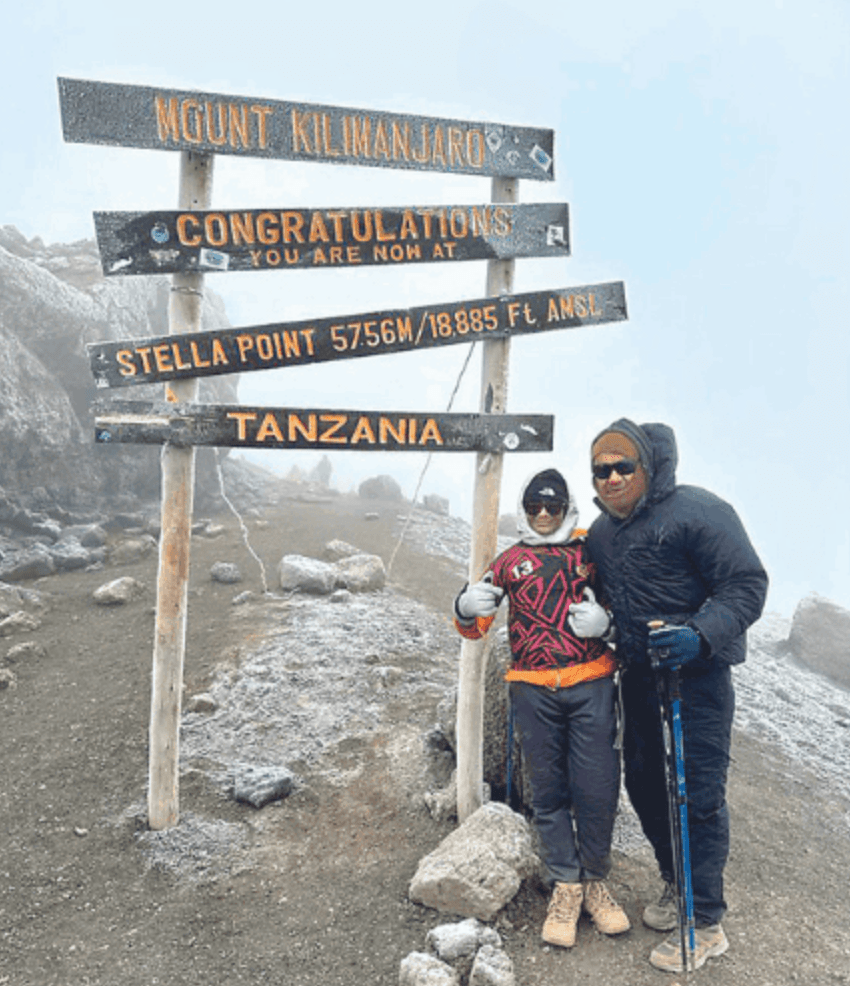
A year ago, my son and I stood at Everest Base Camp. Three years ago, we stood at Stella Point on Kilimanjaro. Two of the highest places I have ever been — and neither, it turns out, is the thing I remember most.
What I remember is who we became on the way up.
When we went to Kili, the idea was mine. I had wanted that mountain for years. I trained, I read, I prepared the way a man prepares when he is trying to prove something — to the mountain, and quietly to himself. Jaith was thirteen. He came because his father was going, and because thirteen-year-olds will follow you into the strangest places if you simply assume they will. He was not ready. I was. So I led. I watched him, I paced him, I carried the parts of it he could not yet carry. At Stella Point, the man led the boy.
It was one of the great privileges of my life.
Then, three years later, the tables turned in a way I did not see coming.
Everest Base Camp was Jaith’s idea. By then he was sixteen, and malli was more than ready — fit, focused, hungry for it in the way I had once been hungry for Kili. And I, for my part, simply did not have the time to prepare. Work, life, the usual thieves. I went in undercooked, and I knew it.
So my son packed the bags.
He packed the bags, he set the pace, he watched me the way I had once watched him, and on the hard days he urged me on — not with sympathy, but with the flat, unsentimental confidence of someone who has decided you are going to make it whether you like it or not. There were moments on that trek when I was being carried, in every sense that matters, by the boy I had carried up another mountain three years before.
At Kili, I led. At EBC, he led.
And somewhere between those two mountains, without either of us announcing it, we stopped being a father and a son climbing together and became two friends who happened to be a father and a son.
Edmund Hillary said it first and said it best: it is not the mountain we conquer, but ourselves. I used to think that was a line about willpower — about gritting your teeth and beating the altitude and the cold and the screaming in your legs. It isn’t. Neither mountain was conquered. Kilimanjaro is exactly where we left it. Everest has not moved an inch. They did not need us, and they certainly did not yield to us.
What changed was us.
We learned, on those two climbs, that leadership is not a position you hold. It is a thing you pick up when the situation needs you to, and — this is the harder part — put down when the situation needs someone else to. I led when I was the one who was ready. He led when he was. Neither of us clung to the role when it stopped being ours. There was no ego in the handover. There was only the climb, and the two of us getting each other up it.
I have spent a working lifetime teaching this in boardrooms — that real leadership rotates, that it lives in the team and not in the title, that the strongest thing a leader can do is recognise the moment to step back and let another rise. I have slides on it. I have a whole thesis on it.
It took a sixteen-year-old packing my bags at the foot of the Himalayas to make me feel it in my bones.
We cheered each other on. We looked after each other. We built, on those two mountains, a friendship and a fundamental respect that has quietly reordered everything between us since. I did not come down from Everest with a conquered mountain. I came down with a son I now count as one of my closest friends — and that is a far better thing to carry home than a summit.
The mountains are still there. They always will be.
It was never them we were climbing.
Everything teaches. Not everyone learns. But somewhere above the clouds, with your son setting the pace, it is very hard not to.


Leave a comment