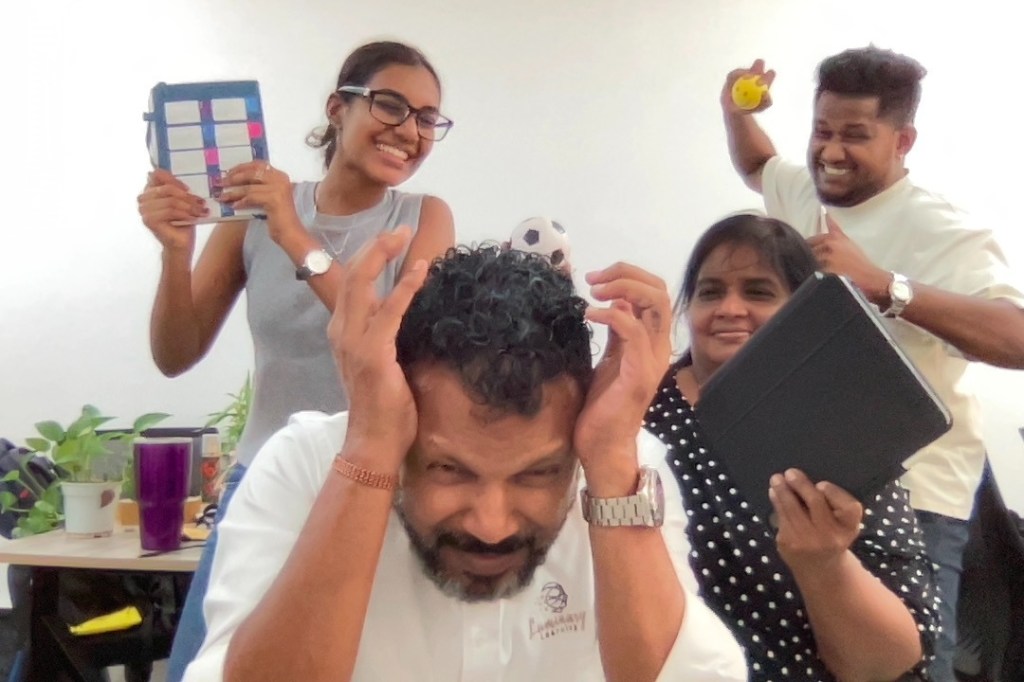
There’s a photo doing the rounds of our office: our CEO, Anton Thayalan, clutching his head — magnificent curls and all — while the team gleefully piles on the chaos around him. Someone’s waving a contraption in the air, someone else is mid-throw, everyone’s grinning. He looks like a man being slowly driven mad. He is, quite clearly, having the time of his life.
I’m not in the photo. And that, oddly enough, is most of what I want to write about.
I’ve been told, more than once and by more than a few, that I’m not ‘serious’. I understand the criticism. I really do. My mother could never quite get her head around it — how I could muck around, lark about, be utterly silly, and yet be dead serious about the thing in front of me at the same time. The two simply didn’t fit in the same person, as far as she could see.
It came to a head during exams. I’d study, then watch a bit of TV. Study some more, then dance to Snap to clear my head. I couldn’t take a break by going for a quiet walk or sitting still — that did nothing for me. I needed something a little daft to reset. To her, the daftness was the problem. To me, it was the engine.
Work was no different. The practical jokes, the lighthearted banter through the day, the loud ties and the colourful shirts (those deserve a post of their own) — all of it read, to a string of superiors, as evidence that I wasn’t taking the job seriously. The logic seemed to be: a serious person looks serious. Sounds serious. Dresses serious. Anything else is a man not pulling his weight.
I’ve spent a good chunk of my working life quietly disagreeing with that logic.
So when we built Luminary Learning Solutions, I was adamant we’d do it differently. Let me be clear about one half of it first, because it matters: we take the work damn seriously. The standard is non-negotiable. We are obsessive about doing GREAT WORK.
But we also muck around. We joke. We take the mickey out of each other. Someone will randomly burst into song and nobody blinks. And — this is the part people miss — if you don’t fancy any of that, if you’d rather sit in a corner with your headphones on and be left entirely alone, that is completely fine too. There’s no judgement either way. You don’t have to perform fun any more than you have to perform seriousness. What you have to do is the work. The rest is just your personality, and your personality is welcome here.
I saw that photo and it took me straight back to my formative years at CCL, with Sajith Kethsiri and Bimsara Jayasinghe— the fun we had while genuinely grafting. That used to be me, slap in the middle of the mayhem. These days, being out of the core operational work means I’m not in the thick of it the way I used to be, and I’ll admit it stings a little to watch from the edge of the frame. So let the record show: had I been in that room, I’d have been right there in the chaos with them — almost certainly the one who started it.
What this is really about
Here’s the bit worth sitting with, because it’s not just a story about a guy in a loud shirt.
We have quietly trained ourselves to believe that solemnity is a proxy for competence. That the person who frowns is working harder than the person who grins. That a serious face means a serious mind. It’s a tempting shortcut for anyone managing people, because frowns are easy to see and good thinking is not.
But it’s a bad proxy. The two things — how serious you are about the work, and how serious you are about yourself — are completely independent. You can be deadly serious about quality, deadlines, clients, and craft, while being entirely unprecious about your own dignity. In fact, I’d argue the people most willing to be silly are often the ones most secure in the work itself. They don’t need the costume of seriousness because the work speaks for them.
The cost of getting this wrong, as a manager, is real. When you reward the appearance of seriousness, you teach your best people to perform instead of contribute. You get tense rooms where nobody risks a daft idea, because daft ideas live next door to the good ones and people have learned to keep both quiet. You confuse a culture of fear for a culture of focus. And you slowly squeeze out the very thing that makes people want to do their best work — the feeling that they can be themselves while they do it.
So if you’re leading a team, ask yourself an honest question: are you judging the work, or the face the work is wearing? Because those are not the same thing, and a lot of good people get quietly written off for the gap between them.
Take the work seriously. Take it as seriously as you like. But I honestly don’t think you have to take yourself all that seriously.
And if the team wants to descend into glorious chaos around the CEO while they do GREAT WORK — they have my blessing. I only wish I’d been there to make it worse.
Everything teaches. Even the mucking around — perhaps especially that.


Leave a comment