On rivalry, ribbing, and what we may be quietly losing in the name of getting everything right.
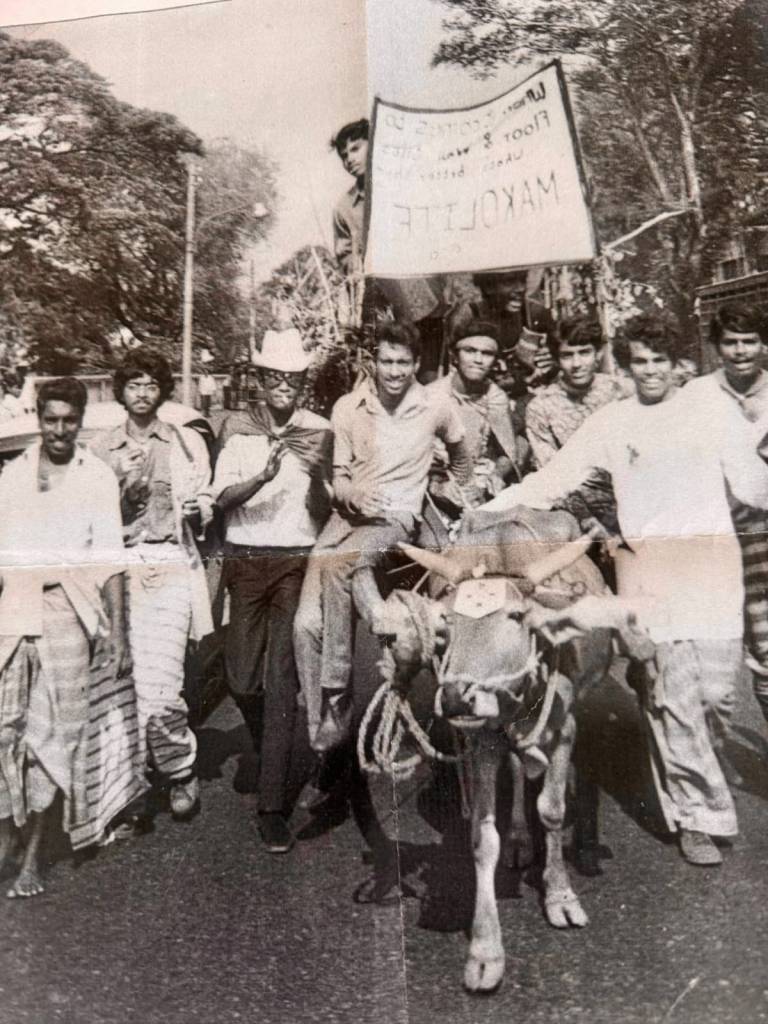
Someone sent me a photograph this week. Black and white, creased down the middle, unmistakably from the seventies. A knot of grinning young men on a Colombo street, walking a bull. But not just any bull. This one had been dressed — lovingly, outrageously — in the Thomian crest, while the cart behind it was done up in Royal insignia. Royalists, in other words, having a glorious time at the expense of their oldest rivals.
I am told a man who went on to become a well-reputed professor is somewhere in that crowd. You would never guess it. In the photo he is just another boy in the scrum, no title, no gravitas, only the easy grin of someone who hasn’t yet learned to be careful. A quick side note : those who know tell me that they were all taken to the ‘cop shed’ for holding up traffic !
The Royal-Thomian is no ordinary fixture. The Battle of the Blues has been played, unbroken, since 1879 — older than the Ashes, which only began in 1882, and one of the oldest uninterrupted cricket rivalries on the planet. Two World Wars, independence, an insurrection, a pandemic, an economic collapse: none of it stopped the match. So when Royalists parade a bull in a Thomian crest, they are not being cruel. They are doing what a century and a half of shared history has earned them the right to do — needle the other side with the kind of affection that only a real rivalry can hold.
My first thought, looking at it, was simply: clean fun.
My second thought, almost in the same breath, was that someone, somewhere, would find a reason to be wounded by it today.
That second thought is the one I have been turning over.
I want to be fair here. The instinct we now call political correctness did not arrive from nowhere. It grew out of real harm — out of the long, ugly habit of laughing at people who never got to laugh back. Much of what we have learned to retire deserved retiring. Sensitivity, at its best, is just good manners with a longer memory. I would not wish that away.
But somewhere along the line, the dial seems to have slipped past calibration and into caution. We have started to flinch before we laugh. We rehearse a joke through three or four imagined courtrooms before we let it out — and by then it isn’t a joke anymore, it’s a risk assessment. The mischief gets sanded off. The bull gets sent home undressed.
And I think we lose something there. Not the right to be offensive — that was never worth much — but the lightness. The capacity to tease the people we love precisely because we love them. A friendship that cannot survive a bit of ribbing was never a strong friendship. A rivalry that needs everyone to be solemn was never a rivalry at all. The boys in that photo are not mocking enemies. They are honouring the most intimate of relationships: the rival you would defend to the death the moment an outsider tried what you yourself do every March.
I notice it in workplaces too. Teams that have learned to be perfectly correct with one another, and perfectly distant. Everyone safe. Nobody close. The hardest thing to teach a careful room is that warmth and a little irreverence usually travel together — and that the absence of the second often hollows out the first.
So I don’t think the answer is to swing back, to mistake cruelty for courage and call rudeness a personality. That bull was not punching down. It was punching sideways, at an equal, in a game both sides had agreed to play. The line was never between offensive and inoffensive. It was between affection and contempt. We have grown very good at spotting offence and curiously bad at telling those two apart.
Maybe the work now isn’t more rules. Maybe it’s better judgement — the kind that lets us be playful without being careless, and kind without being grey.
I keep looking at that boy in the crowd, the one who would become a professor. I suspect the years gave him plenty of dignity. I hope they let him keep the grin.
Everything teaches. Even a bull in the wrong crest.


Leave a comment