And call out the hypocrisy!
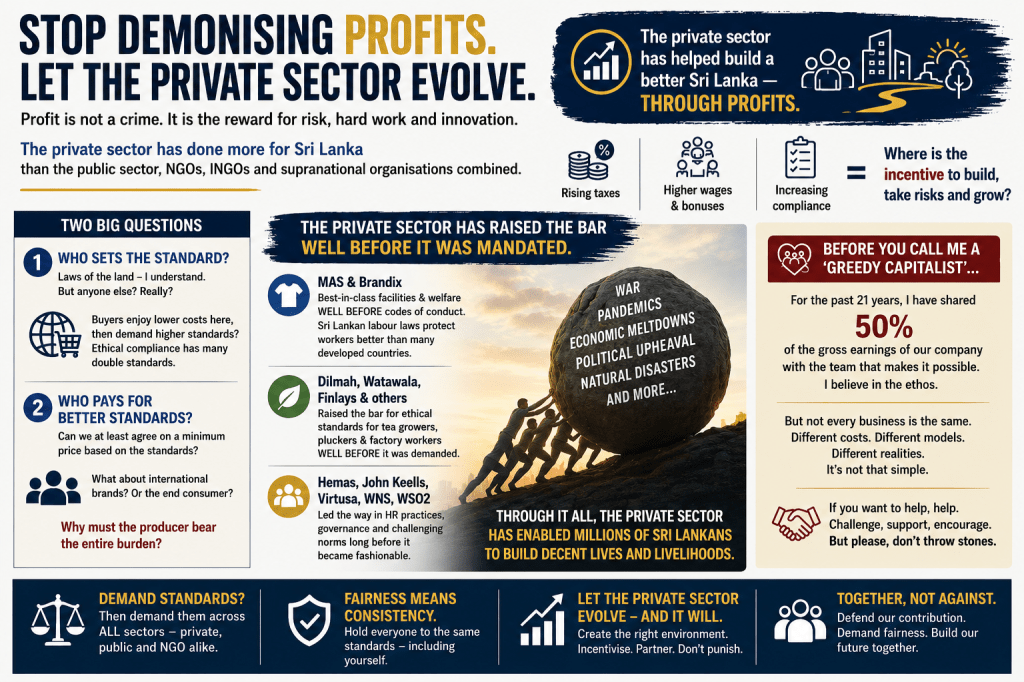
I honestly feel that the private sector gets a lot of bad press for its ‘profit motive’, without due regard or consideration for the the very real fact that the private sector has probably done more for Sri Lanka than the public sector, NGOs, INGOs, and supranational organisations combined.
The issue is that everyone seems to assume that the private sector exists to ‘make the world a better place’ — but conveniently forget the BIG caveat: THROUGH PROFITS. There is a growing vilification of profits, and an increasing demand for corporates to ‘share’ and ‘distribute’ their profits ‘for the greater good’. If that happens — ON TOP OF increasing taxes, demands for higher wages and bonuses, and ever-growing compliance requirements — where exactly is the incentive for an entrepreneur to work hard, take risks, start a business, and grow it?
Then comes the endless call for ‘governance’, ‘equity’, ‘fairness’, and all the other buzzwords that are often thrown around by people who have never really built, run, or managed businesses — or worse, who assume that one or two isolated incidents amount to a ‘systemic issue’. Behind much of this, there is also an unforeseen little ‘business model’ of its own: creating a tidy income stream from the consultations, audits, certifications, and advisory services that are suddenly deemed ‘essential’ to becoming a ‘great place to work’.
I have two BIG issues with all of this:
1. WHO sets the standard?
The laws of the land — I fully understand. But anyone else? Really?
So, global buyers of garments can happily come to lower-cost countries, benefit from the labour arbitrage, and then demand increasingly expensive standards and compliance requirements? ‘Ethical compliance’ has many double standards, including what is and isn’t scrutinised in different countries — something the Sri Lankan garment industry has had to contend with for years.
2. Who PAYS FOR BETTER STANDARDS?
Can we at least agree on a minimum price based on the standards maintained?
The frantic keyboard warriors seem only to demand that industries change. But what about the international brands? Or perhaps we should ask the customer — the end consumer — to actually pay for the changes they demand? Why is the entire burden of financing higher standards expected to be borne by the producer?
My argument is simple: the Sri Lankan private sector has continuously raised the bar WELL BEFORE many of these standards were mandated or fashionable. Let me give a few examples:
- MAS and Brandix consistently had best-in-class facilities and welfare systems WELL BEFORE many of the so-called ‘better countries’ introduced their own codes of conduct. And Sri Lankan labour laws protect workers far better than many developed countries do — certainly more than the United States in many respects.
- Organisations like Dilmah consistently raised the bar for ethical standards for tea growers, pluckers, and factory workers WELL BEFORE it was demanded of them. So did many others, including legacy organisations like Watawala and Finlays.
- Organisations like Hemas continuously raised the bar for HR practices; John Keells led the way in governance; and Virtusa, WNS, and WSO2 consistently challenged norms long before these became fashionable corporate priorities.
Don’t get me wrong — do we still have much to change and improve? Certainly. Absolutely no argument there. Equity is a concern, as is good governance, as is diversity.
All I am saying is: allow the private sector to evolve, rather than demanding change at an unrealistic pace during extremely challenging macroeconomic conditions, and at the cost of sustainable profits. Worse still, stop the demonisation of the private sector simply to drive narrow agendas and, often, ‘Western-funded’ narratives that their own societies and institutions frequently struggle to uphold consistently.
And before anyone jumps on the bandwagon to call me a ‘greedy capitalist’, let me state this clearly: for the past 21 years, I have shared 50% of the gross earnings of our company with the team that makes our success possible. So yes, I absolutely believe in the ethos of sharing value and creating equitable outcomes.
What I do not believe is that because one organisation chooses to do something, every other organisation ought to — or even can. Businesses operate with fundamentally different cost structures, competitive realities, capital requirements, and operating models. To assume otherwise is simply naive.
If you want to help the private sector evolve, then help. Challenge where necessary, support where possible, and encourage better practices where they matter. But please stop throwing stones at the very sector that has, through 30 years of war, pandemics, economic meltdowns, political upheaval, and countless other crises, enabled millions of Sri Lankans to build decent lives and livelihoods.
If standards are demanded, then let them be demanded across ALL sectors — private, public, and NGO alike. Stop demanding more of the private sector while holding it to standards that many of its critics do not hold themselves to.
I genuinely feel that it is time for the private sector to challenge the hypocrisy, defend its contribution with confidence, and demand the same standards of fairness, accountability, and consistency that it is so often expected to uphold itself.
Everything teaches, sadly hypocrites never learn…


Leave a comment